
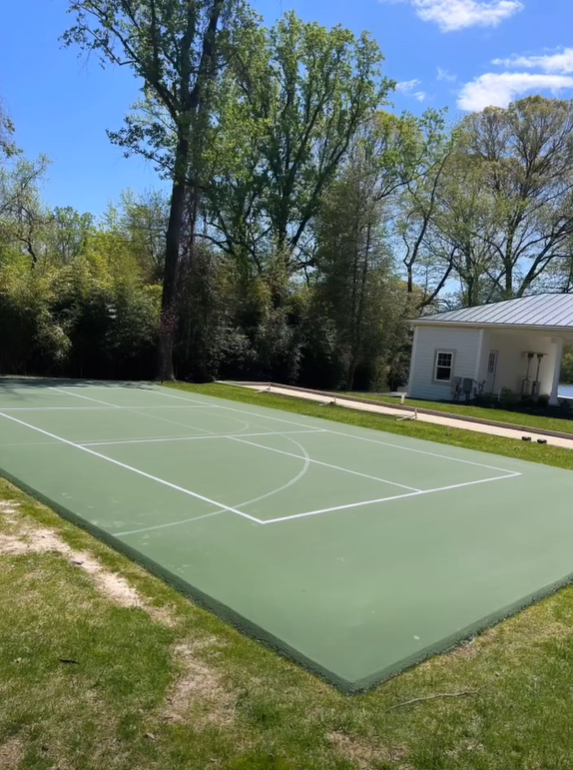
When homeowners talk with us about adding a sport court, the first question is almost always about space. Do we have enough room? Will the court overwhelm the yard? Can we still have grass, a patio, or a play set for the kids? At Back Creek Builders, we hear these concerns all the time, and the good news is that a functional, fun backyard court is often possible on more properties than people think.
Below, we will walk through typical space requirements for different court types, plus a few smart layout strategies to help a court fit comfortably on your property.
Start With Your Primary Sport
The best way to plan is to choose your “priority” sport first, then decide whether to build a dedicated court or design a multi-use layout.
Approximate playing areas for common courts are:
- Pickleball court: about 20 feet by 44 feet, plus some buffer space around the edges
- Half basketball court: often 25–30 feet by 30–50 feet, depending on age and skill level
- Full basketball court: 50 feet by 84 feet for high school play, which is more than many backyards can comfortably accommodate
- Tennis court: 36 feet by 78 feet for doubles play, with a larger overall footprint once we include clear space around the lines
If your yard is modest, a pickleball or half basketball layout usually offers the best balance of playability and space for landscaping and outdoor living.
Remember The Space Around The Lines
Court dimensions on paper only cover the playing surface. For real play, you want additional room around the court so no one feels squeezed against fences or retaining walls.
As a rule of thumb, we like to leave several feet on all sides. This extra space creates safer movement, more comfortable play, and better sightlines. It also gives us room for fencing, lighting, and any small seating areas or benches you want near the court.
When yards are tight, we can adjust features like fence height, retaining walls, and court orientation so the space still feels open rather than boxed in.
Multi-Use Courts For Smaller Yards
If you want variety but do not have the room for separate courts, a multi-use surface can be a smart solution. On one footprint, we can lay out pickleball courts, a half basketball court, and other games for kids.
The key is thoughtful line planning and color selection so the surface remains readable rather than confusing. With the right layout, a single court can support family pickleball matches in the morning, basketball in the afternoon, and casual games in the evening, all without taking over your entire yard.
Court Orientation And Yard Flow
Orientation matters more than many people expect. We look at sun patterns, neighbor views, and how you already use your outdoor spaces. In some backyards, rotating the court by just a few degrees helps reduce glare during peak playtime and creates a better visual relationship with the house, pool, or patio.
We also think about how players, guests, and kids will move from the house to the court. Simple paths, small landings, or seating nooks keep the court connected to the rest of the yard, preventing it from feeling isolated in a corner.
Thinking About Tennis Court Space
For homeowners interested in Annapolis, MD tennis court construction, space planning becomes even more important. A regulation tennis court has a larger footprint than most other residential sport courts, so we talk honestly about whether a full court, a compact practice court, or a different sport might deliver more enjoyment for your family and property.
How We Help You Get It Right
When we design courts at Back Creek Builders, we start with a site visit, measurements, and a conversation about how you truly live and play. From there, we can recommend court size, layout, and features that match both your space and your priorities.
If you are wondering whether your property can support a backyard sport court, we are happy to take a look, talk through options, and help you see what is possible before you commit to a final plan.